Life can move quickly. Between work, relationships, parenting, health concerns, grief, and daily responsibilities, it is easy to focus on everything that is going wrong.
A familiar quote puts it this way:
“Life is like a camera. Just focus on what’s important. Capture the good times. Develop from the negatives. And if things don’t work out, just take another shot.”
It is a simple reminder, but it carries an important truth: difficult moments do not have to define the whole picture.
At New Life Integrated Health, we help individuals, couples, children, and families slow down, gain perspective, and move forward with compassionate, clinically grounded care. For those who want it, counseling can also include a Christian, faith-integrated perspective.
Focus on what matters
When anxiety, conflict, sadness, or stress takes up most of your attention, the important parts of your life can start to feel distant. Therapy creates dedicated space to ask meaningful questions:
What needs my attention right now?
What can I let go of?
Which relationships, values, and habits do I want to protect?
What would a healthier next step look like?
Focusing on what matters does not mean pretending that challenges do not exist. It means choosing where to place your energy instead of allowing worry, fear, or old patterns to make every decision for you.
For some people, that may mean rebuilding communication in a marriage. For others, it may mean working through grief, setting healthier boundaries, supporting a child through a difficult season, or finding practical tools for anxiety and depression.
Capture the good moments
In hard seasons, the brain often becomes trained to scan for problems. That can make small signs of progress easy to overlook. Counseling can help you recognize moments that are worth holding onto:
A conversation that went better than usual
A calmer response during conflict
A child opening up after a difficult day
A new sense of peace, hope, or confidence
A routine that supports your emotional and spiritual wellbeing
These moments may seem small, but they matter. They are often evidence that healing is already taking shape.
Develop from the negatives
In photography, a negative is not the final image; it is part of the development process. In life, painful experiences are not automatically good, and no one should be expected to minimize real hurt. But with the right support, it can be possible to learn from what happened without remaining trapped in it.
Therapy can help you process difficult experiences, understand emotional patterns, and identify tools that support lasting change. Faith-integrated counseling can also offer room to explore questions of purpose, forgiveness, identity, hope, and God’s presence in the middle of hardship—at a pace that respects your beliefs and comfort level. New Life Integrated Health provides Christian counseling as an option for clients seeking faith-integrated mental health support.
Take another shot
Sometimes the plan does not work. A relationship becomes strained. A goal is delayed. Old feelings return. You may feel like you should have handled something differently.
That does not mean you have failed. A new attempt can look like:
Reaching out for support instead of carrying everything alone
Trying a different way to communicate with your partner
Beginning counseling for the first time
Returning to therapy after a break
Asking for help for your child, teen, or family
Making space for your emotional health alongside your spiritual life
You do not need to have every answer before taking the next step. You only need to be willing to begin.
Counseling in Connecticut
If life feels out of focus, compassionate support is available. New Life Integrated Health provides individual therapy, couples and marriage counseling, family therapy, child and adolescent therapy, grief counseling, nutrition counseling, and Christian counseling. Services are available in Shelton, Connecticut, with telehealth options for eligible clients across the state.
Ready for a clearer next step?
You deserve a place to be heard, supported, and equipped with practical tools for the season you are in. To learn more or request an appointment, call New Life Integrated Health at (203) 951-1858 or complete the patient inquiry form on the website.
If you have ever wondered whether you can talk to a therapist who truly understands your faith without having to choose between professional mental health care and your spiritual convictions you are not alone. Many people in Connecticut and across the country are discovering that Christian counseling offers a path that honors both.
In this article, “Christian counseling” refers to therapy provided by licensed mental health professionals who can integrate faith when welcomed by the client. Pastoral, lay, or church-based counseling may be different.
This article explains what Christian counseling is, how it works, what to expect in a session, and how it differs from other forms of support. Whether you are actively looking for a counselor right now or simply curious, the goal is to help you make an informed decision.
What Is Christian Counseling?
Christian counseling is a form of professional mental health therapy provided by licensed clinicians who integrate biblical truth, prayer, and a Christian worldview into the therapeutic process when the client welcomes that integration.
The key word is licensed. Christian counseling is not the same as pastoral counseling, lay counseling, or a conversation with a minister. It is clinical therapy delivered by licensed mental health professionals — such as Licensed Professional Counselors (LPCs), Licensed Marriage and Family Therapists (LMFTs), and Licensed Clinical Social Workers (LCSWs) — who use the same evidence-based methods you would find in any therapy practice, including cognitive behavioral therapy (CBT) and family systems approaches.
What makes it distinct is the option to weave faith into the clinical work. As New Life Integrated Health explains on its Christian counseling page, sessions “combine evidence-based clinical techniques (like CBT) with, when welcomed by the client, prayer, scripture reflection, and discussion of faith as it relates to your challenges”.
How Christian Counseling Differs From Pastoral Counseling
It is common to confuse Christian counseling with pastoral counseling, but there are important differences:
Pastoral Counseling
Christian Counseling
Provider Training
Pastor, minister, or church leader Theological education, pastoral care
Licensed mental health professional Clinical graduate degree, state licensure, evidence-based methods
Focus Scope
Spiritual guidance, biblical counsel Short-term support, spiritual direction
Clinical mental health treatment with optional faith integration Diagnosed and undiagnosed mental health concerns
Insurance
Typically not covered by insurance
Billed like standard therapy; may be covered by insurance
Pastoral counseling can be deeply meaningful, and many pastors are gifted caregivers. But pastors are not trained to diagnose or treat mental health conditions, and their counseling is usually short-term and spiritually focused. Christian counseling brings clinical expertise to the same kinds of struggles anxiety, depression, marriage conflict, grief, family dynamics with the added option of faith integration.
How It Differs From Secular Therapy
The clinical foundation is the same. A licensed Christian counselor uses the same evidence-based techniques as a secular therapist. The difference is integration.
In secular therapy, the clinician’s personal worldview may or may not align with yours, and faith is typically not part of the conversation unless you bring it up. In Christian counseling, the therapist can provide care through a Christian faith-informed lens and can incorporate Scripture, prayer, and biblical perspectives into the work at whatever level you are comfortable with.
Some clients want faith woven throughout every session. Others simply want a counselor who shares their values but prefer sessions to stay more clinically focused. As New Life Integrated Health puts it, “You guide how much faith is part of the conversation”
What Happens in a Christian Counseling Session
If you have never been to therapy before, it helps to know what to expect. While every counselor has their own style, a typical Christian counseling session follows a structure similar to traditional therapy:
The first session is about getting to know you. Your counselor will ask about what brought you in, your history, your goals, and your comfort level with faith integration. This is also a time for you to ask questions and get a sense of whether the fit feels right.
Ongoing sessions focus on the work itself. Depending on what you are navigating anxiety, depression, marriage conflict, grief, family stress, or something else your counselor will use evidence-based techniques to help you identify patterns, develop coping skills, and work toward meaningful change. If you welcome it, prayer, Scripture reflection, and a biblical perspective can be part of that process.
You are always in control. Faith-based content is never pushed. If you want to start with a more clinical approach and bring faith in later, that is completely fine. If you want prayer in every session, that is available too. The pace and depth of faith integration is yours to set.
Who Can Benefit From Christian Counseling
Christian counseling can support people facing a wide range of challenges, including:
Anxiety, worry, and panic
Depression and discouragement
Marriage and relationship struggles
Family conflict and parenting challenges
Grief, loss, and life transitions
Stress, burnout, and caregiver fatigue
Spiritual struggles, doubt, and questions of purpose
Forgiveness, guilt, and shame
It is also for people who are not sure where they stand with faith. You do not need to be a practicing Christian to benefit. As New Life Integrated Health notes, “We welcome individuals from all backgrounds who are seeking this approach. Some clients are Christian and want their faith actively incorporated into treatment; others simply appreciate a values-based or faith-informed lens even if they don’t identify as religious”
The approach is rooted in broad, foundational Christian principles rather than the doctrine of any one denomination. Whether you identify as Catholic, Protestant, Evangelical, non-denominational, or another tradition — or none at all — sessions can be tailored to reflect your beliefs and comfort level.
Does Insurance Cover Christian Counseling?
This is one of the most common questions people ask, and the answer is encouraging: at New Life Integrated Health, Christian counseling is billed the same as standard therapy and may be covered by the insurance plans the practice accepts. Because the sessions are delivered by licensed clinicians using evidence-based methods, there is no clinical distinction between a Christian counseling session and a standard therapy session from a billing standpoint.
That said, coverage depends on your specific plan. It is always a good idea to verify your benefits before starting. You can call your insurance company directly, or the practice can often help you check.
How to Find a Christian Counselor in Connecticut
If you are looking for a Christian counselor in Connecticut, here are some practical steps:
Start with directories. The Psychology Today therapist directory allows you to filter by faith category and location — search for “Christian counseling” in Connecticut to find licensed providers. The Christian Counselor Directory (christiancounselordirectory.com) and the AACC’s Christian Care Connect (aacc.net) are also dedicated resources for finding faith-based therapists.
Check credentials. Make sure the counselor is licensed by the State of Connecticut (LPC, LMFT, LCSW, or equivalent) and has experience with the concerns you want to address. Licensure ensures the clinician has completed the required education, training, and supervision.
Ask about faith integration. Not every Christian therapist integrates faith the same way. Some weave it throughout; others keep it available but optional. Ask how they approach it and whether they can tailor it to your comfort level.
Consider logistics. Think about whether you prefer in-person or telehealth sessions, whether the practice accepts your insurance, and whether their availability works with your schedule.
Schedule a first appointment. The first session is a chance to see if the fit feels right. If it does not, it is okay to try a different counselor. The therapeutic relationship is one of the most important factors in successful outcomes.
Christian Counseling in Connecticut
If you are in Connecticut, New Life Integrated Health offers Christian counseling at its Shelton office and through secure telehealth anywhere in the state. The practice serves individuals, couples, families, and children, with licensed clinicians who tailor faith integration to each client’s comfort level. With more than 20 years of combined experience, the team provides a compassionate, confidential space to work through life’s challenges — with the option to bring your faith into the room.
To learn more about Christian counseling in Shelton, CT or telehealth across Connecticut, call New Life Integrated Health at (203) 951-1858 or complete the patient inquiry form.
This article is for educational purposes only and is not a substitute for professional mental health care. If you are in crisis or need immediate support, call or text 988 or dial 911.
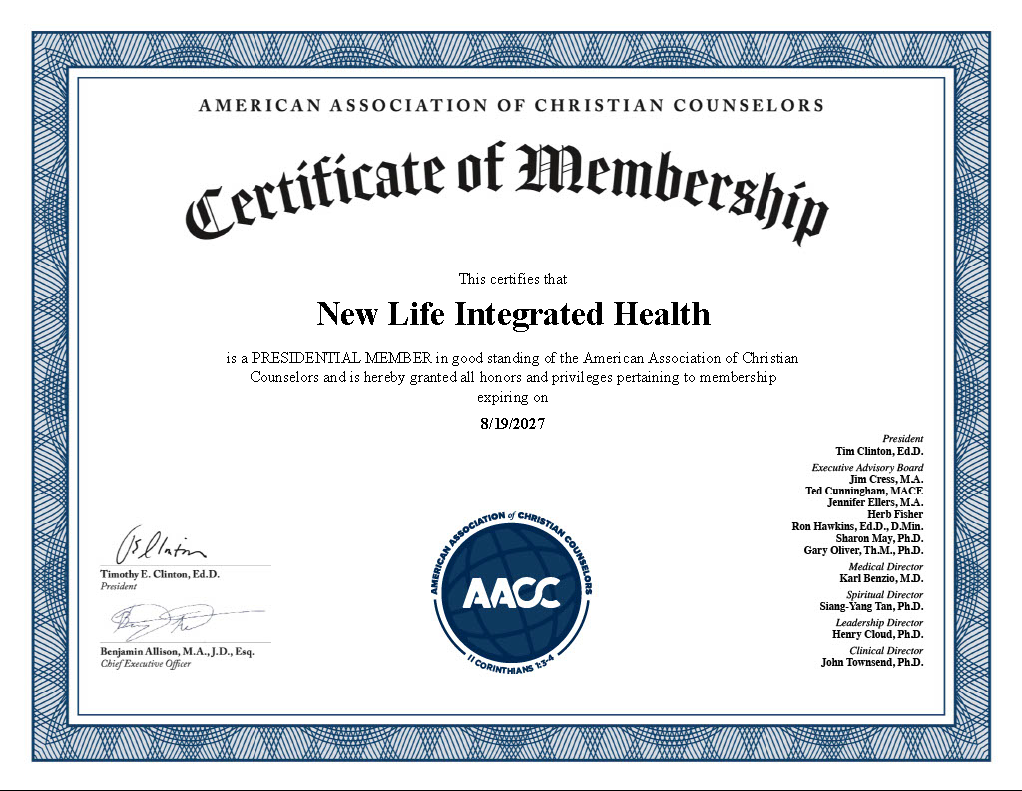
The Wellness Group, our practice, is a Presidential Member of the American Association of Christian Counselors. See the credentials behind our care team.
If you are considering therapy for the first time, you may have noticed that some therapists describe themselves as Christian counselors while others offer traditional, secular therapy. Both can be legitimate forms of mental health care when provided by qualified professionals and they share more in common than you might think.
In this article, “Christian counseling” refers to therapy provided by licensed mental health professionals who can integrate faith when welcomed by the client. Pastoral, lay, or church-based counseling may be different.
Understanding the difference can help you choose the approach that fits your values, preferences, and goals. This article breaks down what each one looks like, where they overlap, and how to decide which is right for you.
What Traditional Therapy Looks Like
Traditional therapy sometimes called secular therapy is professional mental health treatment provided by licensed clinicians using evidence-based methods. The therapist’s role is to help you understand your thoughts, emotions, and behaviors, develop coping strategies, and work toward the changes you want to see in your life.
In traditional therapy, the clinician’s personal beliefs are generally kept separate from the therapeutic work. The focus is on clinical techniques such as cognitive behavioral therapy (CBT), psychodynamic therapy, family systems therapy, or other evidence-based approaches applied to the concerns you bring to session.
Traditional therapy can support a wide range of mental health concerns, including anxiety, depression, trauma, relationship conflict, grief, and life transitions. It is the standard of care in the mental health field and is what most people picture when they think of going to a therapist.
What Christian Counseling Looks Like
Christian counseling shares the same clinical foundation as traditional therapy. It is provided by licensed mental health professionals using the same evidence-based methods. The clinician has the same training, the same licensure, and the same ethical obligations.
The difference is that the therapist can provide care through a Christian faith-informed lens and can integrate faith into the therapeutic process when the client welcomes it. This might include:
Discussing how faith relates to the challenges you are facing
Bringing in Scripture or biblical perspectives on topics like anxiety, forgiveness, marriage, or grief
Incorporating prayer into sessions, if you would like that
Exploring your spiritual life as part of your overall mental health
The key is that faith integration is client-directed. As New Life Integrated Health explains, “You guide how much faith is part of the conversation — some clients want it woven throughout, others just want a counselor who shares their worldview but keeps sessions more clinically focused.”
Key Differences — and Important Similarities
Here is a side-by-side comparison to make the distinction clear:
Traditional Therapy
Christian Counseling
Provider
Licensed mental health professional
Licensed mental health professional
Methods
Evidence-based (CBT, family systems, etc.)
Same evidence-based methods
Worldview
Clinician’s beliefs are set aside
Clinician can provide care through a Christian faith-informed lens
Faith in sessions
Typically not part of the conversation unless you raise it
Can be integrated when welcomed — Scripture, prayer, biblical perspective
Insurance
Covered like any therapy session
Covered like any therapy session
Who it serves
Anyone
Anyone — you do not need to be Christian to benefit
The most important similarity is also the most overlooked: the clinical foundation is identical. Both are provided by licensed therapists using evidence-based techniques. The difference is not in the quality of care it is in whether faith is available as part of the conversation.
Which Approach Is Right for You?
There is no universally right answer. The best approach depends on your values, your preferences, and what you want from therapy. Here are some questions to help you decide:
Consider Christian counseling if:
Your faith is an important part of your life, and you want it included in your healing process
You want a therapist who shares your worldview and understands the role faith plays in your decisions and relationships
You are navigating something that has a spiritual dimension doubt, guilt, forgiveness, purpose, or a faith crisis and you want a space where that can be explored
You simply want to know your counselor is coming from a place of shared values, even if you do not want faith to be a major focus
Consider traditional therapy if:
You prefer to keep faith out of the therapy room entirely
You want a clinician whose personal beliefs are completely separate from the clinical work
You are not religious or do not identify as Christian and would prefer a secular approach
You can also choose both. Because the clinical foundation is the same, some people start with one approach and shift over time. What matters most is the therapeutic relationship — finding a counselor you trust and feel comfortable with.
Can You Switch Between Them?
Yes. Because Christian counseling and traditional therapy use the same clinical methods, transitioning between them does not mean starting over. If you begin with a traditional therapist and later decide you want faith to be part of the conversation, you can seek out a Christian counselor and vice versa.
Some practices, including New Life Integrated Health, offer both. Their clinicians can tailor the level of faith integration to your comfort, meaning you do not necessarily have to switch providers if your preferences change over time. As their team notes, “The clinical foundation is the same licensed therapists using evidence-based methods. The difference is integration.”
A Note on Insurance and Access
One common misconception is that Christian counseling is a specialty service not covered by insurance. In practice, because Christian counseling is delivered by licensed clinicians using standard evidence-based methods, it is billed the same way as any therapy session. At New Life Integrated Health, Christian counseling is billed the same as standard therapy and may be covered by the insurance plans the practice accepts. Coverage depends on your specific plan, so it is always wise to verify your benefits before starting.
Finding the Right Fit in Connecticut
If you are in Connecticut and trying to decide between traditional therapy and Christian counseling, the most practical step is to reach out and talk to a provider. A good therapist will listen to what you are looking for, answer your questions, and help you determine whether their approach is the right fit without pressure.
New Life Integrated Health offers Christian counseling in Shelton, CT and through telehealth anywhere in Connecticut. Their licensed clinicians provide individual therapy, couples and marriage counseling, family therapy, child and adolescent therapy, grief counseling, and nutrition counseling with the option to integrate faith at whatever level you choose. You do not have to be Christian to benefit, and faith-based content is never pushed.
This article is for educational purposes only and is not a substitute for professional mental health care. If you are in crisis or need immediate support, call or text 988 or dial 911.
Finding the right Christian counselor is an important step toward emotional, relational, and spiritual healing.
Christian counseling should provide more than practical guidance—it should offer compassionate care that is grounded in biblical truth while helping individuals navigate life’s challenges with wisdom, grace, and hope.
At New Life Integrated Health, we believe that lasting healing addresses the whole person: mind, body, and spirit. A Christian counselor should create a safe, supportive environment where clients can explore their struggles while growing in their relationship with God.
What Makes a Good Christian Counselor?
A qualified Christian counselor combines professional clinical training with a sincere commitment to biblical principles. While every counselor has a unique style, there are several qualities that are essential.
A Genuine Love for People
Christian counselors are called to serve others with compassion, patience, and humility. They recognize that every individual has inherent worth because they are created in the image of God. Whether someone is experiencing anxiety, depression, grief, marital conflict, trauma, or spiritual struggles, a caring counselor walks alongside them with empathy and respect.
A Strong Foundation in Biblical Truth
Christian counseling is rooted in the belief that Scripture provides timeless wisdom for life’s challenges. While evidence-based therapeutic techniques can be valuable, biblical truth remains the foundation for understanding hope, forgiveness, restoration, and personal growth.
Many Christian counselors draw encouragement from passages such as 2 Peter 1:2–4, Hebrews 4:12, and 2 Timothy 3:16–17. These verses remind believers that God’s Word equips us for growth, wisdom, and faithful living.
A Personal Relationship with Jesus Christ
A Christian counselor should demonstrate an authentic and growing relationship with Jesus Christ. Their faith influences how they care for others, offer encouragement, and approach life’s difficulties with hope rooted in the Gospel.
Integrity and Spiritual Maturity
Wisdom, humility, honesty, and accountability are important characteristics of an effective Christian counselor. Many counselors remain actively involved in a local church and seek ongoing spiritual growth alongside their professional development.
Questions to Ask Before Choosing a Christian Counselor
Choosing a counselor is a personal decision. Asking thoughtful questions can help determine whether the counselor’s approach aligns with your spiritual beliefs and counseling goals. Consider asking questions such as:
How would you describe your counseling approach?
How do you integrate biblical principles into the counseling process?
What role does Scripture play during counseling sessions?
Do you pray with clients who desire prayer?
How does your Christian faith influence the care you provide?
What education, training, and clinical experience do you have?
What therapeutic methods do you commonly use?
Are you involved in a local church community?
What types of concerns or populations do you specialize in serving?
How do you help clients experience lasting growth and healing?
Building a Relationship of Trust
Effective counseling is built on trust, honesty, and mutual respect. You should feel comfortable discussing your concerns openly and confident that your counselor listens carefully, treats you with compassion, and provides thoughtful guidance.
If you do not feel that a counselor is a good fit, it is appropriate to seek another professional whose approach better meets your needs. Finding the right counselor can make a significant difference in your healing journey.
At New Life Integrated Health, we believe Christian counseling is more than offering encouragement—it is the compassionate ministry of applying God’s truth to the real struggles of everyday life. A faithful Christian counselor seeks to care for the whole person: spiritually, emotionally, relationally, and psychologically.
A good Christian counselor is someone who:
Loves God and Loves People
Jesus taught that the greatest commandments are to love God and love our neighbors (Matthew 22:37–39). Christian counselors serve with genuine compassion, humility, patience, and grace, reflecting Christ’s love to those who are hurting.
Has a Growing Relationship with Jesus Christ
Effective Christian counselors demonstrate spiritual maturity through a vibrant relationship with Christ. They pursue personal holiness, spend time in prayer and Scripture, and depend on the Holy Spirit for wisdom and guidance.
Grounds Their Counsel in God’s Word
Christian counselors believe that Scripture is God’s inspired, authoritative, and sufficient Word, providing wisdom, hope, and direction for every aspect of life (2 Timothy 3:16–17; Hebrews 4:12; 2 Peter 1:3). Biblical truth serves as the foundation for understanding life’s challenges and pursuing lasting transformation.
Offers Clinical Excellence with Biblical Wisdom
Professional Christian counselors combine sound clinical knowledge with biblical principles. They utilize evidence-based therapeutic approaches when appropriate while ensuring their care remains consistent with Christian faith and values.
Points People to Christ
The ultimate goal of Christian counseling is not simply symptom relief but lasting transformation through Jesus Christ. Counselors seek to help individuals grow in faith, find hope in God’s promises, strengthen relationships, and develop practical tools for overcoming life’s challenges.
Walks with Others Through Suffering
Christian counselors understand that suffering is part of living in a fallen world. Rather than offering quick fixes, they faithfully walk alongside people through grief, anxiety, depression, trauma, addiction, marital conflict, and other life struggles, trusting that God can bring redemption even in the midst of hardship (Romans 8:28).
Speaks Truth with Grace
Faithful counselors balance compassion with honesty. They create a safe, confidential, and nonjudgmental environment where clients are loved unconditionally while being gently encouraged toward biblical truth and healthy change.
Demonstrates Integrity and Professionalism
Christian counselors uphold the highest standards of ethics, confidentiality, accountability, and professional competence. Their character reflects honesty, humility, wisdom, and respect for every individual made in the image of God.
A Trusted Guide
A good Christian counselor is someone your pastor, church leader, or trusted Christian friend would confidently recommend because they provide biblical, compassionate, clinically competent, and Christ-centered care.
Begin Your Healing Journey Today
You do not have to choose between professional mental health care and your faith. At New Life Integrated Health, you can have both. Call (203) 951-1858 or complete our patient inquiry form to schedule your first appointment.
Located in Shelton, Connecticut, New Life Integrated Health provides faith-based mental health services to residents throughout Fairfield County and the Naugatuck Valley, including Trumbull, Stratford, Derby, and Ansonia. Whether you prefer confidential in-person sessions at our Shelton office or secure telehealth appointments from anywhere in CT, our Christian counselors are here to support your family’s emotional and spiritual well-being.